
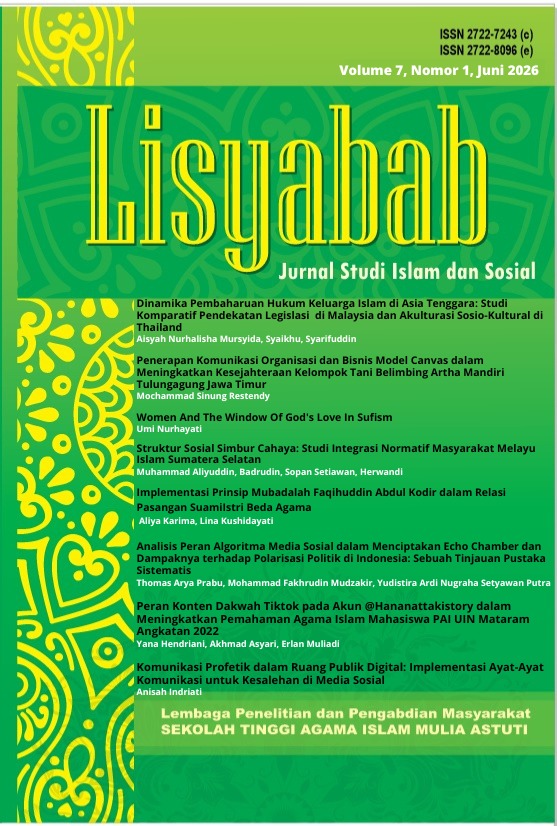
Prophetic Communication in the Digital Public Space: Implementing Verses of Communication for Piety on Social Media
Abstract
This study aims to explore the application of prophetic communication principles in the digital public sphere, particularly on social media, and to identify how Quranic verses on communication can be applied to enhance piety in digital communication. This study used a qualitative approach, using textual analysis of Quranic verses governing communication principles, as well as interviews with active social media users.
The results indicate that principles such as qawlan sadīdan, qawlan karīman, and qawlan layyinan can reduce the spread of hoaxes and hate speech, and improve the quality of interactions on social media. The application of prophetic communication principles can also help create a more ethical, peaceful, and inclusive digital public sphere. However, challenges such as audience diversity and anonymity on social media need to be addressed for these principles to be effectively implemented. This research contributes to the development of Islamic communication theory in the digital context by providing practical insights into the application of Islamic values-based communication principles on social media. The implication of this research is the need for regulations and policies that support the implementation of communication ethics on social media to create a healthier and more respectful digital space.
Downloads
References
Research in Psychology 3 (2): 77-101. https://doi.org/10.1191/1478088706qp063oa
Creswell, John W., and Cheryl N. Poth. 2018. Qualitative Inquiry & Research Design: Choosing Among
Five Approaches. 4th ed. Thousand Oaks: Sage Publications.
Gee, James P. 2014. An Introduction to Discourse Analysis: Theory and Method. 4th ed. New York:
Routledge.
Kentmen‑Cin, Cigdem. 2025. “Hate Speech on Social Media: A Systemic Narrative Review of Political
Science Contributions.” Social Sciences 14 (10): 610. https://doi.org/10.3390/socsci14100610
Mawaliya, Kusnadi, dan Aristhopan Firdaus. 2025. “Etika Komunikasi Perspektif Al‑Qur’an dalam
Menanggulangi Ujaran Kebencian di Media Sosial.” Journal of Literature Review 1 (2): 49–68.
https://doi.org/10.63822/631gvd52
Pew Research Center. 2021. "Social Media and Political Polarization." Pew Research Center.
https://www.pewresearch.org
Rosenberg, Marshall B. 2003. Nonviolent Communication: A Language of Life. Encinitas:
PuddleDancer Press.
Shihab, Quraish. 2014. Tafsir al-Mishbah: Pesan, Kesan, dan Keserasian Al-Qur'an. Jakarta: Lentera
Hati.
Ștefăniță, Oana, and Diana Maria Buf. 2021. "Hate Speech in Social Media and Its Effects on the LGBT
Community: A Review of the Current Research." Romanian Journal of Communication and Public
Relations 23 (1): 47–55. https://doi.org/10.21018/rjcpr.2021.1.322
Fakhira, Amirah Jilan, and Marlya Fatira. 2021. “Pemahaman Etika Komunikasi Islam Terhadap
Moralitas Pengguna Media Sosial.” SERAMBI: Jurnal Ekonomi Manajemen dan Bisnis Islam 3 (2): 41–
50.
Suliyanti, Suci, Tahir, and Fuad Fansuri. 2024. “Islamic Communication Ethics in Social Media
Information Services.” Jurnal Ilmiah Mahasiswa Raushan Fikr 13 (1): 162–173.
https://doi.org/10.24090/jimrf.v13i1.11018
Janah, Futihatul. 2020. “Etika Komunikasi di Media Sosial Melalui Prinsip SMART (Salam, Ma’ruf,
Tabayyun) Perspektif Al-Qur’an.” JAWI: Jurnal Administrasi dan Humaniora Islam 3 (2).
https://doi.org/10.24042/jw.v3i2.8068
Novianti, N. F. 2023. “Relevansi Etika Komunikasi Islam dalam Bermedia Sosial dengan Fatwa MUI
Nomor 24 Tahun 2017.” Journal of Islamic Social Science and Communication (JISSC) DIKSI 2 (2): 87–
98.
Munawaroh, Siti, and Nina Siti Marlina. 2025. “Ethics of Social Media Communication from an
Islamic Perspective: A Qualitative Study of Muslim Practices in Indonesia.” International Journal of
Communication and Public Discourse 2 (1): 44–53.
Larsson, Gustav. 2024. “Muslims and Social Media: A Scoping Review.” Information, Communication
& Society.
Shodiqoh, R. 2024. “Social Media Ethics in a Contemporary Islamic Perspective.” Sicopus Journal of
Islamic Communication and Society 4 (2): 153–69. https://doi.org/10.61455/sicopus.v2i03.153
Anggraini, Novi. 2024. “Etika Komunikasi Bagi Pengguna Media Sosial Menurut Al-Qur’an.” Journal of
Comprehensive Islamic Studies (JOCIS) 3 (1): 242–60 https://doi.org/10.56436/jocis.v3i1.242
Jenuri, Jenuri, Dina Mayadiana Suwarma, Muhamad Parhan, Ade Sartika, Ahmad Djubaeri Ramdani,
and Feby Auliya Rahmah. 2021. “Islamic Communication Ethics Towards Hoax Phenomenon on
Social Media.” Dialogia: Jurnal Studi Islam dan Sosial 19 (2): 515–534.
https://doi.org/10.21154/dialogia.v19i2.3446
Wati, Desy Rahma. 2023. “The Ethics of Social Media Communication in the Perspective of the
Al-Qur’an.” Journal of Islamic Communication and Counseling (JICC) 2 (2): 93–107.
https://doi.org/10.18196/jicc.v2i2.28
Nurul Saniah dan Muhammad Farhan. 2023. “Etika Komunikasi Islam dalam Pemanfaatan Media
Sosial.” ISME: Journal of Islamic Studies and Multidisciplinary Research 1 (2): 41–49.
Copyright (c) 2026 Anisah Indriati

This work is licensed under a Creative Commons Attribution-NonCommercial-ShareAlike 4.0 International License.
.png)


2.png)


